





Five Questions About Succos and Simchas Torah

Q. I want to purchase a brook willow for planting in my yard and want to make sure I have the correct species for use on Sukkot. Could anyone confirm the correct species? I believe it to be Salix Acmophylla or possibly Salix Alba. Please let me know which is kosher and what the species is called. Thank you so much.
A. Thanks for your very interesting question.
The traditional halachic sources don't define the arava's species, they describe its appearance: it's long and smooth and it has a red stem. It's possible that more than one species fits the bill. (It's noteworthy that different types of willow grow all over the world and halacha never insisted that a particular species be imported from Israel. Apparently, more than one type of local willow is acceptable.)
Looking at the preponderance of sources (and accounting for how authoritative they are), it looks like Salix acmophylla the way to go. Salix alba appears not to be recommended as its leaves are a little rough, rather than smooth. Salix babylonica is certainly not usable as arava.
I hope this helps!
***************************
Q. When did the term Simchas Torah first appear?
A. Thanks for your question. The practice to dance with the Torah on Simchas Torah goes back to the Geonic period, but the day does not appear to acquired that name until the Middle Ages. (At least, we don't appear to have any record of it earlier than that.)
*****************************
Q. Why don't we say L’Dovid on Simchas Torah?
A. There are a number of different customs as to when one stops saying L'Dovid. To me, the one that makes the most sense is to end on Hoshana Rabbah. This is because (a) L'Dovid makes references to Succos, and Hoshana Rabbah is the last day of Succos and (b) Hoshana Rabbah is the last day of the judgment period that started with Elul. So, I think the question isn't "Why don't we say L’Dovid on Simchas Torah," it's "Why DO we say it on Shemini Atzeres?" I think the answer is the same as why many people still eat in the succah on Shemini Atzeres – because of the possibility that it might still be Succos. No matter how you slice things, however, Simchas Torah, certainly isn't.
*********************************
Q. Which is objectively the happier and more festive holiday – Purim or the ancient, Temple-era Simchat Beit Hasho'eva festival on Chol Hamoed Sukkot? (Because both are each described as happier and more freilech than any other holiday or observance.)
A. Thanks for your very interesting question. I don't think there's objectively one "happiest" day. I think they're all different in their focus and observance. For example, is a wedding necessarily a more joyful occasion than Purim? Perhaps not, but most people certainly make bigger weddings than they do Purim seudos. Similarly, the simchas beis hashoeiva was a celebration held in the Mikdash. We're told that if you never saw it, then you never saw real celebration, but does that mean it outranks Purim in terms of joy? And what about people who weren't there? Similarly, Purim is a chag that we're told will never cease but does mean that it's necessarily the most joyful? (The Mishna in Taanis [4:8] says Tu b'Av and Yom Kippur were the happiest days, but it doesn't mention Purim!) So, I think that each occasion has its own unique nature and comparing them is a case of apples and oranges.
*****************************
Q. Are our contemporary Simchat Torah festivities, which were taken up initially just by Ashkenazi Jews a few hundred years ago, ultimately descended from the ancient Simchat Beit Hasho'eva festival?
A. As far as Simchas Torah, I have never heard that it was modeled on the ancient simchas beis hashoeiva. We certainly don't refer to it as such, and we do refer to Succos parties by that name. (Also, Simchas Torah isn't even on Succos; it's on Shemini Atzeres, which a completely different holiday.) I imagine that those who set the date of Simchas Torah might have been inspired by its proximity to Succos, but I suspect it's more likely that they wanted a particularly joyful conclusion to the holiday season overall.
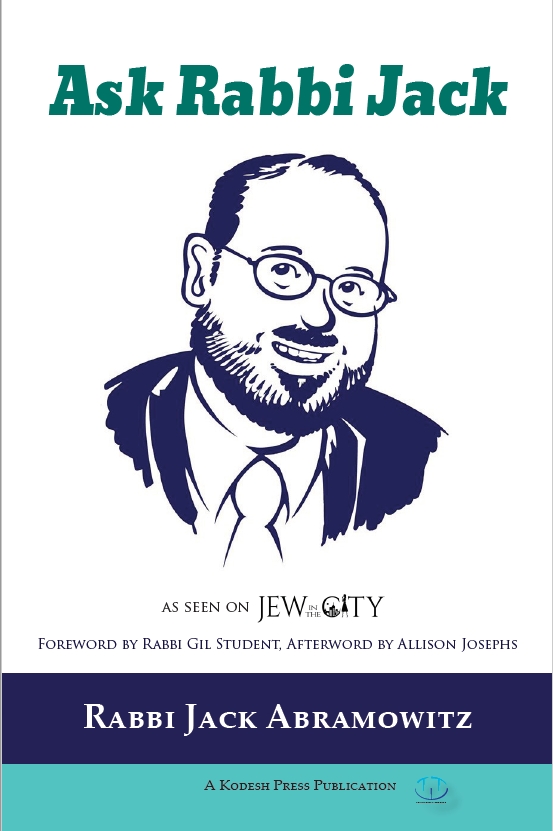
Rabbi Jack's book Ask Rabbi Jack is available from Kodesh Press and on Amazon.com.
Next In This Series