





Torah, Tanach, "Old Testament" and Apocrypha

Q. I would like to know how the Tanach was written and collected and kept until today.
I would also like to know about the Apocrypha. Was it included in the earliest Tanach, then it was removed? Or was it never included in the first place?
Would you please kindly guide me to where I can read about these topics?
A. The Bible canon was locked in by the Anshei K’nesses HaGedolah (the “Men of the Great Assembly”) in the second or third century BCE. In order to be included, a work had to be the product of Divine inspiration, which the Anshei K’nesses HaGedolah were uniquely qualified to determine. (The last of the prophets were among the members of the Great Assembly.) A work like The Wisdom of Ben Sira (AKA The Alphabet of Ben Sira, AKA Ecclesiasticus) may have been respected – it’s even quoted in the Talmud – but it’s excluded from the Bible canon because it’s not the product of Divine inspiration.
The books of the Apocrypha were never included in the Bible canon – most of them probably appeared too late even to have been considered. Something like the book of Maccabees is valued as a historical account but it was written after prophecy ceased and could never have been included in the canon.
This pamphlet might prove useful: Tanach - Nach on OU - OU Torah
---------------------------------------
Q. When we say Hashem gave Moshe the Torah, do we picture a physical Torah falling from the sky? Or is it more metaphorical and Hashem gave Moshe the Torah through divine prophecy? At what point was the Torah divided into 5 books? By Hashem or people? And any reason why 5 books, why not just 1? Thanks.
A. Thanks for your question. Hashem dictated the Torah and Moshe wrote it down. Our tradition is that the Torah is inherently five “books.” The books are not a human division like the chapter and verse breaks are. Of course, the Torah is one book, so perhaps we should say that it’s five “volumes” or “sections.” Each book has a different didactic purpose: the lessons of our Patriarchs, the Exodus from Egypt, the laws of sacrifices, the travels in the wilderness and Moshe's farewell speeches.
Here's a fun fact: The Talmud says that the Torah is actually made up of seven books! Numbers 10:35-36 are considered a “book” unto themselves, so the seven “books” of the Torah would be (1) Genesis, (2) Exodus, (3) Leviticus, (4) Numbers up to 10:34, (5) Numbers 10:35-36, (6) the rest of Numbers and (7) Deuteronomy. Ultimately, it’s all one pie; the difference is in how we slice it!
--------------------------------------
Q. I am researching to see the difference between the Torah and The Old Testament Isaiah 10. Thank you.
A. I'm afraid I don't understand the question. Both the Torah and the Book of Isaiah are part of the Jewish Bible, what you call the “Old Testament.” I took a quick look in Isaiah chapter 10 to see if anything leaped out as appearing to be at odds with the Torah but nothing did. Please clarify what, specifically, you would like to know.
------------------------------
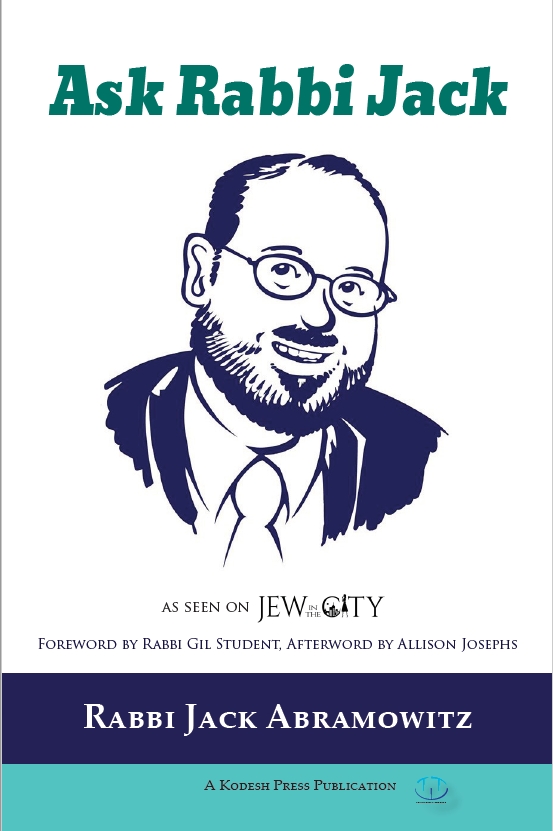
Rabbi Jack's book Ask Rabbi Jack is available from Kodesh Press and on Amazon.com.
Next In This Series