





Bava Basra - Daf 51

Daf Images are property of Vagshal and may not be reproduced.


- Audio Timestamps
0:00 - The 3 Sugyos
2:44 - Review of 3 Sugyos
5:21- Siman
7:43 - 4 Blatt Back Chazarah
16:05 - Pop Quiz (Last 7 blatt)
For access to all Zichru resources including PDFs, and illustrations CLICK HERE
- If a man who sells property to his wife can claim לגלויי זוזי הוא דבעי
The Mishnah on Daf 42a taught that a woman cannot establish a chazakah in her husband’s property, which implies that if she presents proof she acquired it from him, the proof is accepted. The Gemara asks: לימא לגלויי זוזי הוא דבעי – let [the husband] say he was trying to uncover money of his which she had hidden from him, and did not intend to sell her the property!? Since the proof is accepted, we can derive from the Mishnah that המוכר שדה לאשתו קנתה – one who sells a field to his wife, she acquires it, and we do not say his purpose was to discover money she had hidden!? The Gemara answers that the Mishnah can mean that if she presents a שטר מתנה – a gift document, proving the husband gifted the property to her, her proof would be accepted, since this could not be used to reveal hidden money.
At the end of the Daf, Rava rules such a sale to be void, if it was purchased במעות טמונים – with hidden money. If it was purchased with מעות שאין טמונין – money which was not hidden, the sale is valid.
- When a שטר of sale acquires property
Rav Nachman told Rav Huna that they had ruled the previous evening that if one sells a field to his wife, the sale is valid (and he cannot claim he was trying to discover hidden money). Rav Huna asked that this ruling was obvious for a different reason: דל זוזי מהכא ותיקני בשטרא – remove the money from this discussion, and let her acquire the property with the שטר, since a Mishnah teaches that land can be acquired with money, a שטר, or chazakah!? Rav Nachman responded that Shmuel taught this only applies to a שטר מתנה – a gift document, but a sale document does not acquire property until money is given. Although a Baraisa teaches if a שטר states: שדי מכורה לך – “My field is hereby sold to you,” or שדי [נתונה] לך – “My field is hereby given to you,” הרי זו מכורה ונתונה – it is sold or given, apparently proving that a שטר of sale does transfer property, Rav Hamnuna explained it refers to מוכר שדהו מפני רעתה – one selling his field because of its poor quality, who wants to finalize the sale immediately. Alternatively, Rav Ashi explains the Baraisa is actually discussing a single case of a gift, as he explains.
- Does the husband receive produce from property which he sold to his wife?
Rav Huna bar Avin sent the following message: המוכר שדה לאשתו – if one sells his field to his wife,
קנתה ובעל אוכל פירות – she acquires it, and the husband receives its produce, like any property she acquires from elsewhere. However, Rebbe Abba, Rebbe Abahu, and all the גדולי הדור said he does not receive its produce: במתנה בקש ליתנו לה – he actually wanted to give it to her a gift (from which a husband does not receive produce, since it is given generously), and the reason he wrote the שטר as if it was a sale was: כדי ליפות את כחה – to enhance her rights, entitling her to compensation if the land is collected by the husband’s lender. Although "רברבי" – great [Rabbis] (Rav), ruled that the husband receives produce from land he sold her, Rav Chisda still ruled he does not, because other "רברבי" (Rebbe Yochanan) ruled this way. Rava concludes that the halachah is the husband does receive produce from land he sold to her, but not from land he gifted her.
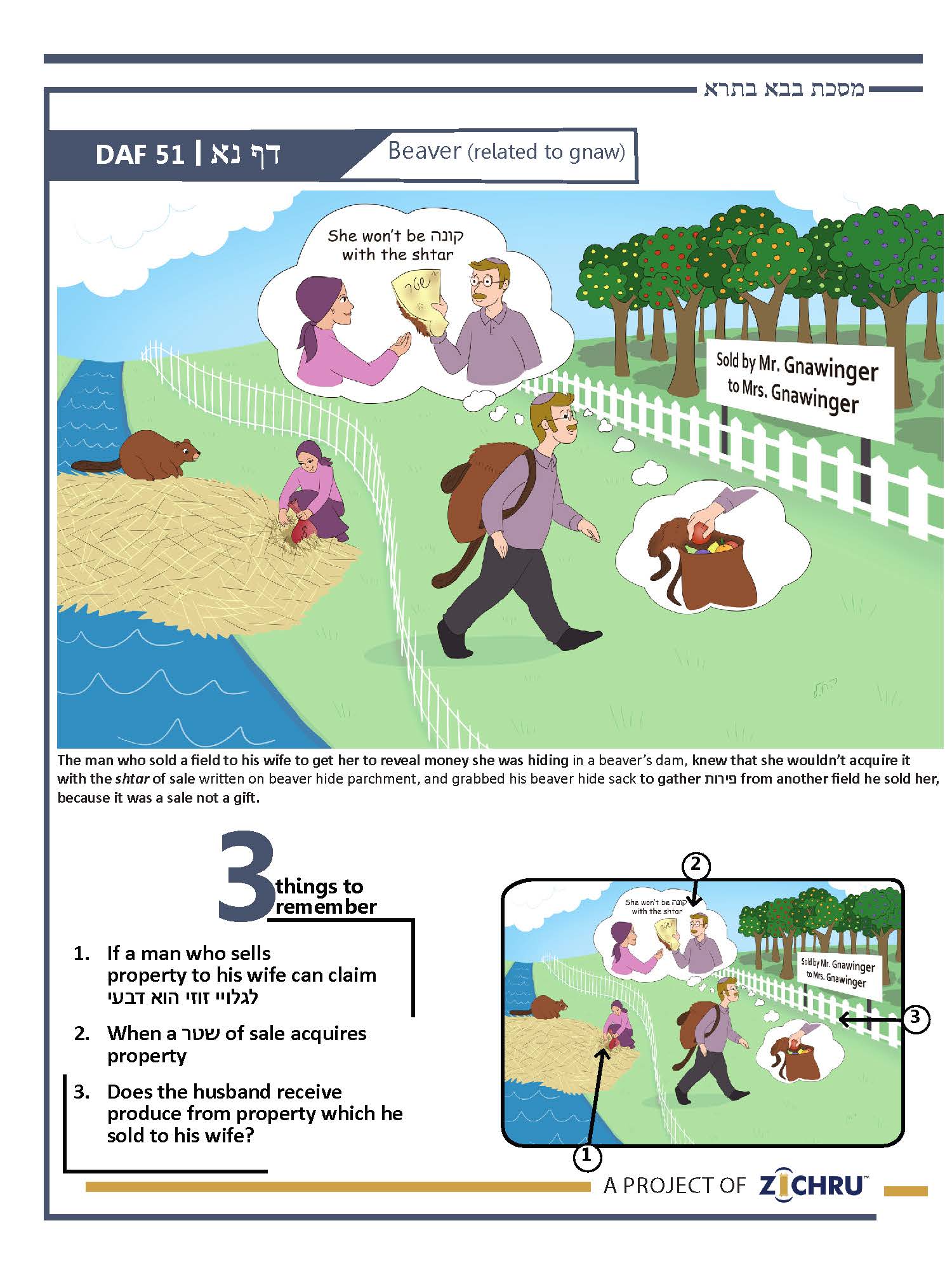
Siman – Beaver (related to gnaw)
The man who sold a field to his wife to get her to reveal money she was hiding in a beaver’s dam, knew that she wouldn’t acquire it with the shtar of sale written on beaver hide parchment, and grabbed his beaver hide sack to gather פירות from another field he sold her, because it was a sale not a gift.
Next In This Series